The Late Mr Alex Macfarlane of Achray
When we look at the old Amuri Country Cottage Hospital today, it is easy to think first of the nurses who worked there, the babies born within its walls and the generations of local families who depended upon it. Yet before the first foundation was laid, there had to be something even more fundamental: land.
That land came from the Macfarlane family of Achray, and in particular from the estate of the late Mr Alexander (Alex) Macfarlane, whose name belongs among the early benefactors of healthcare in the Amuri district.
The story of Alex Macfarlane is also part of a much larger North Canterbury story — the remarkable story of the Macfarlane family, Scottish immigrants who became major pastoralists and helped shape the agricultural landscape of the province.
From Scotland to North Canterbury
The Macfarlanes were among the great pastoral families of nineteenth-century Canterbury. Their story began with John Macfarlane, who came from Scotland to New Zealand in the early years of European settlement. After first spending time in the Wairau Valley, he travelled south and developed a particular affection for the country around the Amuri Basin.
Family accounts describe how, in 1846, John first saw the low hills and open country around the Lowry Hills Range and became determined that one day he would farm there. He eventually established a substantial pastoral empire, acquiring properties including Coldstream, Hawkswood, Lyndon, Kaiwarra and Achray. (Tim Fulton)
John married Catherine Cameron in 1848. Together they raised eleven children, an extraordinary family by any standard, particularly in the demanding conditions of early colonial New Zealand.
Their children became deeply associated with North Canterbury pastoralism. Six of their sons — Malcolm, John, James, Walter, David and Alexander — became farmers in the region and were later remembered as part of the generation sometimes described as the “Wool Kings” of Canterbury. (Tim Fulton)
It was this family inheritance of land, farming knowledge and enterprise into which Alex Macfarlane belonged.
Achray — a Macfarlane home
By the 1870s, John Macfarlane had begun acquiring substantial properties for his sons. Among them was Achray, the estate that would become particularly associated with Alexander.
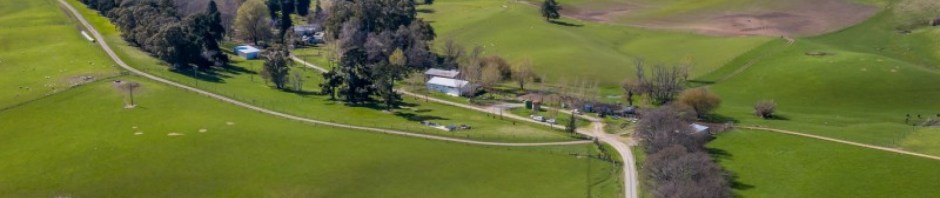
Achray lay beside Rotherham, in the heart of the Amuri pastoral country. It was sheep country — broad paddocks, open hills, stockyards, wool and working dogs, with the seasonal rhythm of shearing, mustering and stock sales determining much of life.
A remarkable glimpse of Achray survives in the photographic collections of the National Library of New Zealand. An album of Canterbury sheep stations dating from the late nineteenth century includes Achray, identified simply as “Macfarlane”, alongside many of the great pastoral properties of Canterbury. The collection records not only homesteads but woolsheds, farm buildings, livestock and the people who worked on them. (National Library of New Zealand)
The estate was substantial. In 1913, after Alexander’s death, the Achray property was advertised for public auction as 8,268 acres of freehold land, divided into fourteen agricultural and pastoral blocks. The sale notice described it as adjoining Rotherham township and noted that the estate had been in the Macfarlane family for approximately forty years. (Papers Past)
That places Achray firmly within the story of Rotherham itself. The township and the estate were neighbours, and the fortunes of each were inevitably connected.
Alex Macfarlane
Alexander Macfarlane was known familiarly as Alec or Alex. He was a substantial farmer and pastoralist rather than a public figure who sought attention beyond his district.
One of the most revealing references to him comes from a later recollection of the Macfarlane family. Gordon Fulton, who worked for his uncle Alec, remembered Alexander as the man who employed him as manager at Achray and Mount Stewart. The account places Alec firmly within the working pastoral life of the district and records that he continued managing the estate until Alexander’s death in 1913. (Tim Fulton)
The official agricultural records of the period also confirm his presence. Government sheep returns repeatedly list A. Macfarlane of Achray, Rotherham, among the significant sheepowners of Amuri County. (Papers Past)
He was therefore not simply a landowner whose name appeared on a map. He was part of the farming community that made Amuri what it became.
A gift whose importance grew with time
Perhaps the most enduring part of Alex Macfarlane’s story, however, concerns what happened to a portion of his land after his death.
The history of Amuri Manor records that approximately nine acres of land were obtained from the late Mr Alex MacFarlane of Achray for the proposed hospital site. The hospital plans had already been approved by the North Canterbury Hospital Board in August 1919, and construction eventually followed. (Amuri Manor)
There is an important chronological point here. Alexander died in 1913, while the hospital plans were approved in 1919 and the building opened in January 1922. The contemporary evidence therefore suggests that the land transaction was associated with his estate rather than necessarily being a personal donation made by Alex himself immediately before construction.
Nevertheless, the connection is significant. The hospital was ultimately established on land that had belonged to Alex Macfarlane and the Achray estate.
That distinction makes the story no less meaningful. In fact, it adds another layer to it: the land of a great pastoral estate was transformed into a place devoted not to sheep or farming, but to the health and welfare of the surrounding community.
From paddock to hospital
The transformation was remarkable.
The hospital was conceived as a rural cottage hospital suited to the needs of a scattered farming population. In an age when roads could be difficult and journeys to larger centres arduous, having medical and maternity care close to home could make an enormous difference.
The local community itself contributed generously to the project. In 1921, district residents raised £1,652 19s, while construction proceeded despite shortages and rising costs. The completed building opened in January 1922. (Amuri Manor)
The hospital subsequently became a place where babies entered the world, accidents were treated, patients recovered and families gathered around loved ones.
And beneath all of this community life was the ground once associated with Achray.
A family woven into North Canterbury
The Macfarlane legacy extended far beyond Alexander himself. His family was woven deeply into the agricultural history of the Amuri and wider Canterbury region.
The brothers and their descendants farmed properties across North Canterbury, and succeeding generations continued the family association with agriculture, education, military service and public life. The National Library also holds Macfarlane family papers and diaries from the First World War period, illustrating how widely the family’s story extended beyond the farm. (National Library of New Zealand)
The Macfarlanes were part of the generation that transformed Canterbury’s grasslands into a highly productive pastoral economy. Their names remain attached to properties and landscapes that still help define the region.
Yet perhaps one of the most quietly significant chapters of their story is here at Rotherham.
Remembering Alex
Alex Macfarlane died in 1913, before the hospital that would ultimately occupy part of his former estate opened its doors.
He could never have known the countless people who would later walk across that ground: mothers arriving to give birth, injured farm workers, nurses beginning their shifts, doctors making their rounds, anxious families waiting for news and, eventually, generations of children proudly saying they were “born at Rotherham.”
That is the remarkable thing about places.
A piece of land may begin as a farm, become part of an estate, pass through an inheritance and then acquire an entirely new purpose. The physical landscape changes, but the history accumulates.
Today, Amuri Manor stands as a surviving reminder of that transformation. Its walls tell the story of rural medicine, its rooms recall the nurses and patients who occupied them, and the surrounding land quietly connects the building back to an earlier generation of North Canterbury pastoralists.
Among those remembered should be Alex Macfarlane of Achray.
His legacy is not simply the story of a farmer, a large sheep station or a prominent Canterbury family. It is also the story of land that became part of something larger than itself — a place where a rural community could care for its sick, welcome its newborns and support its neighbours.
In that sense, the old Achray land became something rather special.
A place once devoted to sustaining stock became a place devoted to sustaining people.
And more than a century later, that is a legacy well worth remembering.
Sources and further reading
- Amuri Manor, “Amuri Country Cottage Hospital — Rotherham’s Little Hospital with a Big Heart”, including the history of the hospital site and the Macfarlane land. (Amuri Manor)
- Lyttelton Times, 1 May 1913, “Achray Estate Sold by Public Auction”, recording the 8,268-acre estate and its Macfarlane ownership. (Papers Past)
- Tim Fulton, “Straight off the Tussock — Chapter 3”, including recollections of Alec Macfarlane, Achray and the wider Macfarlane family. (Tim Fulton)
- National Library of New Zealand, E. Wheeler & Son photograph album of Canterbury sheep farms and homesteads, including a late nineteenth-century photograph of Achray. (National Library of New Zealand)
- New Zealand Parliamentary sheep returns, documenting A. Macfarlane of Achray, Rotherham, among the district’s pastoralists. (Papers Past)

