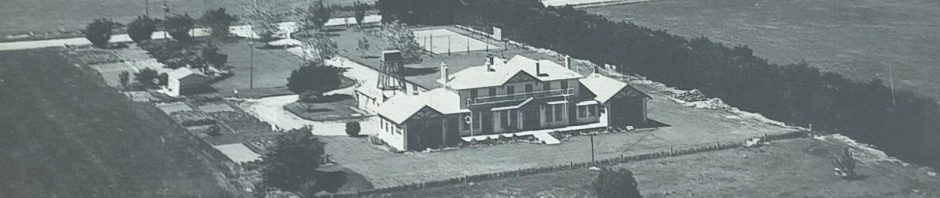
Caring for the Amuri District since 1922
Tucked on the outskirts of the village of Rotherham stands a concrete building that means the world to local families — the Amuri Country Cottage Hospital, known to most simply as Rotherham Hospital.
Completed in January 1922, this was a true community hospital — paid for, staffed, and cherished by the people of the Amuri. It stood at the heart of one of New Zealand’s most rural districts, where long distances, rough roads, and winter floods could make travel to larger towns impossible.
Here, mothers gave birth, injured farm workers were patched up, and neighbours dropped in to visit patients or bring soup to the nurses.
🩺 A “Cottage Hospital” for Country Life
Cottage hospitals were common in rural New Zealand from the early 1900s.
They were small, home-like places — part hospital, part house — with verandahs for fresh air and big windows to let in the light.
Rotherham’s was built in the same spirit:
- A few maternity beds for local births
- A small ward for medical or accident cases
- Living quarters for the matron and nursing staff
- A cheerful kitchen and sitting room where community life continued even in illness
It was simple, but it saved lives.
👩⚕️ Nurses, Neighbours, and Newborns
For almost forty years, the hospital’s nurses and matrons were the district’s quiet heroes.
They drove out in storms to attend home births, treated shearing cuts and broken bones, and delivered hundreds of Amuri babies.
Local families still recall being born “at Rotherham” — a mark of pride that linked generations.
The hospital was not just a medical centre but a place of comfort, trust, and belonging.
🕰️ Changing Times
By the late 1950s, better roads and bigger regional hospitals made small facilities like Rotherham’s harder to keep open.
The Amuri Country Cottage Hospital closed around mid 1960’s, ending an era of local care.
The building was later converted into a private home, but much of its original concrete structure and character remains — a visible reminder of a community’s commitment to one another.
🌿 A Legacy of Care
Though the patients and nurses have long gone, the spirit of the Amuri Hospital lives on in the district’s sense of community and the continuing importance of rural healthcare.
Today, the building stands as a symbol of care, courage, and connection —
a tribute to the people who believed that even a small town deserves a place to heal.
🗓️ Key Dates
| Year | Event |
| 1922 |
Some nine acres of land were obtained from the Late Mr Alex MacFarlane of Achray, on the outskirts of Rotherham and plans for a “Cottage Hospital” were prepared by the architects Collins and Harman by Mr Joseph Munnings; These plans were approved by the Board in August 1919 and soon after, a tender of £7,700 from Mr J Taylor, was approved for construction in concrete, plaster walls and poilite roofing. (Norris, The North Canterbury Hospital Board, p.101. Amuri Hospital, Rotherham is also omitted from the list but this does not necessarily indicate Munnings’ lack of involvement as he was probably still in Christchurch when the plans were submitted in August 1919. The name ‘Collins, Harman and Munnings, Ch.Ch.’, on the Amuri Hospital plans is not in Munnings’ hand. There is an option given in the tender notice for this hospital; it was an option for the quote to be given for a wooden building or a concrete building, and there are two sets of plans. The plan for the timber building is held in the Macmillan Brown Archives, University of Canterbury: MB 2160, Trengrove Blunt Architectural Collection, I,D 140172. The plan for the concrete building is held at Canterbury Museum, Christchurch: Collins and Harman, Ref. 4323 and 4324. The hospital was built in concrete and features 4 inch double concrete exterior walls, with a 3 inch space. The aggregate was obtained from the property.)The Minister gave consent for the building in March 1920 and the Board of Trade permit was issued in June. District residents donated £1,652-19-0 in 1921 and in spite of material shortages and cost increases, the modern building was opened in January 1922. It had 15 rooms, 5 bathrooms and 2 kitchens. The Nursing Division director, Miss H McLean, appointed Miss C Blackie as Matron and the hospital was operating. In 1922, a doctor’s house was obtained with £740 of local money, however this attractive home was destroyed by fire in 1936 and a replacement was planned, in concrete. By 1925 it was realised that the hospital was serving relatively few maternity cases and instead of local needs, was being used primarily for convalescence of patients from Christchurch Public Hospital. |
| 1920s–1950s |
By 1931, with the depression affecting the country, the Board recognised that the Amuri Hospital had been over-built for the surrounding needs and being isolated it was difficult to staff with high calibre professionals; finances also at this time were limited. Nonetheless most of the money for construction had come from the district and the Board could do little but continue, knowing well that although Country Hospitals were now difficult to justify, there was strong opposition to closures. Served as maternity and general hospital for the Amuri district. 1933 Aroha Clifford NZ first aviator died two weeks after childbirth. |
| c.1960 | Amuri Hospital was eventually closed in 1960’s and medical services in the district are now managed from Medical Centres. |
| 1972 onwards |
The building was sold and has been converted to a large residence, though many facets of the hospital remained for many years. The first purchaser, Harry Cockburn, had won the Golden Kiwi in 1972, for $20,000 and purchased it for $12,000. He also built the Helicopter hanger. At one point a local band called “The Puffins” resided here. The Puffins were a vibrant glam rock band that emerged in Christchurch during the mid-1990s. They gained recognition for their energetic performances and distinctive style. The band’s frontman, Lindon Puffin (born Lindon McCormack), was known for his dynamic stage presence and theatrical flair. Their music blended elements of glam rock with a unique New Zealand twist, earning them a dedicated following in the local music scene. The Puffins, disbanded in the early 2000s, as members moved overseas, joined other bands, or became occupied with other pursuits. This led Lindon to embark on a solo career, re-emerging in the early 2000s with a new set of songs and a more reflective outlook thebigcity. Their final performance as a band was in 2000, Lindon later reflected on the band’s legacy, describing their music as “a blend of heartfelt acoustic, country, rock and folk music,” and noting that their sound drew comparisons to artists like Chris Knox, Elvis Costello, and Morrissey Christchurch City Libraries. Despite their relatively short existence, The Puffins left a lasting impact on the Christchurch music scene, and their legacy continues to influence emerging artists in the region. Artist in Residence Mike Ebel made showings at Leithfield’s Pukeko Junction Cafe. The residence was then rented out to various groups and family’s until stable ownership from 2000’s to 2024. Extensive damage was made to the building because of the 2016 Kaikōura earthquake. It was a Mw 7.8 earthquake that occurred two minutes after midnight on 14 November. Ruptures occurred on multiple faults and the earthquake has been described as the “most complex earthquake ever studied”. Wikipedia Date: 14 November 2016
Aftershocks: 20,200 (as of 22 November 2017)
Areas affected: New Zealand
Casualties: 2 dead; 57 injured
Depth: 15.1 km (9.4 mi)
Duration: ~ 2 minutes
Epicentre: 42°44′13″S 173°03′14″E / 42.737°S 173.054°E; 15 km (9.3 mi) north-east of Culverden
Some like to refer to the Rotherham earthquake rather than Kaikōura!
From about 2003 to 2024 was owned by the Midgley family.
|
| 2025 |
The current owners, Sarah and Michael McGregor, bought it in Dec 2024 and are continuing the restoration of the property (begun by earlier owners) to a high standard, this work nearing completion. Opened 18th October 2025 as Amuri Manor Historic Hospital Boutique Accommodation 1922 (Airbnb) Today it has 5 guest rooms (old staff quarters upstairs), 5 bathrooms (all showers and 1 bath), 7 toilets and 1 kitchen. |
📜 Sources
- Hurunui District Council – Amuri Concept Development Plan
- Winifred Norris (1942), North Canterbury Hospital Board: Fragments of History
- Local reporting and oral histories (Claire Inkson, 2023)
- Te Ara – The Encyclopedia of New Zealand, “Hospitals”
- Architect of Empire: Joseph Fearis Munnings 1879-1937 A thesis Heulwen Mary Roberts University of Canterbury 2013
Names located (pre-1960) — with context & sources
Mr Joseph Munnings – Partnership with Collins and Harman (1919-1922) Independent Practice (1922-1923)
A plaque commemorates Joseph F. Munnings, the architect for the extensions of the Christ Church Cathedral, Grafton, Aunstralia, who died in 1937 before the work was completed.
Mr. Joseph F Munnings, who died suddenly during Wednesday night (as already reported), was a foremost Sydney architect. He was a partner in the firm of Messrs. Power, Adams and Munnings, of George street, architects for the extensions to the Grafton Cathedral, and had been a member of the Board of Architects of New South Wales for the past seven, years. He was for some time a member of the Civic Design Committee, at Canberra, under the chairmanship of Sir John Butters, and a member of the Building Advisory Committee of the City Council.
Mr. Munnings, who was 58 years of age, was a native of New Zealand, where, in 1895, he was apprenticed to a builder to gain some practical knowledge of building and materials before commencing the usual architectural training. He was then articled to an architect for four years. He went to England to continue his studies in 1903, and spent three years abroad. He then returned to New Zealand, and entered into practice at Christchurch. In1909 he again visited England, and passed the final examination for the Associateship of the Royal Institute of British Architects, and was elected a member of the Concrete Institute, now the Institute of Structural Engineers. In 1910 he was appointed consulting architect to the Government of Eastern Bengal, and Assam. On the repartitioning of Bengal, he was transferred to the province of Bihar and Orissa, where he designed the scheme for the new capital of Patna, in addition to many large works in other parts of the province. Mr. Mannings, then came to Sydney, and in 1922 he joined the firm with which he was associated up till his death. He designed a number of large buildings in the city, and suburbs. These included colleges, business premises and residences. Daily Examiner (Grafton, NSW ), 4 October 1937.
Staff (matrons / nurses held in public records)
- Miss C Blackie — 1922 appointed Matron by the Nursing Division director, Miss H McLean, and the hospital was operating.
- Miss Randall — appointed Matron, around the hospital’s opening (c.1922); reported to have resigned by March 1924. Papers Past+1
Context: Papers Past periodical notices mention “Nurse Randall, of Christchurch Hospital, has been appointed matron of the Amuri Hospital, Rotherham” (Oct 1922) and a later note that “Miss Randall … has resigned” (Mar 1924). Papers Past+1 - Miss Letitia Lindsay — referenced in a 1926 periodical as having “for some time been matron of the Amuri Cottage Hospital, Rotherham.” Papers Past
- Nurse Pinkerton — noted in a 1926 periodical as having “for some time been matron of the Amuri Cottage Hospital Rotherham” (appears alongside other matron appointments). Papers Past
- Sister Jean Nevin — midwife 1940’s after the war “I remember Sister Niven – she could hold a baby in the palm of her hand!”
- Nurse Amy Maude Wooding (married Roberts) — her chair is in the Nurse’s room and we also have her wedding china tea set.
- Nurse Pester – Relief nursing at Rotherham and meet Barry Pester at one of the local dances. Subsequently in 1959 I (Dean Pester) was born there (not long before it was closed)
- Nurse June Macfarlane
- Sister Emma Maria Stricke — 1950’s
Doctors held in public records
- Dr Gilbert Todd — 1911
- Dr Jennings —
- Dr Turkett —
- Dr and Mrs L. Ball — 1926
- Dr Smale — 1929
- Dr McLean —
- Dr W G Todd —
- Dr William Dickle — 1950 -1960
Amuri Community Health Centre
Opened in June 26 2011 (new building) born from the old hospital to deliver healthcare in the Hurunui. Back in the 60’s and 70’s June Gardiner fought to save the hospital from closure, leading her to take up a position on the North Canterbury Hospital Board. She continued to promote rural health issues on this Board, for 25 years.
Dr Janne Bill — 1979-2004 worked hard for the district
Dr Meikham – “OMG I remember Dr Meclam – not sure of spelling lol. In the Rotherham Dr’s rooms. So do I!! Always just gave us liquid penicillin” “Dr Meek was always calling in to raid Mum’s (Dot Black) baking tins. If there was nothing in them he would leave them upside down on the kitchen table if Mum wasn’t home!!” “Dr Meik delivered my first baby at Waikari hospital 1970..and I’m pretty sure he lit up (a cigarette) in the delivery room after it. “
Patients / births (examples found in public genealogical / local sources)
- Clarence Maxwell (Max) Cone — birth recorded as born in Rotherham Hospital, Amuri, 20 Feb 1922 (genealogical sources / family histories). This is an example of a named patient born at the hospital in the early 1920s. winsomegriffin.com+1
What our other guests have said
Get in Touch
Have any questions? Contact us.
021976666
Connect with us
Check us out on Social Media
 Amuri Manor – Boutique Country Accommodation | Historic 1922 Hospital, North Canterbury