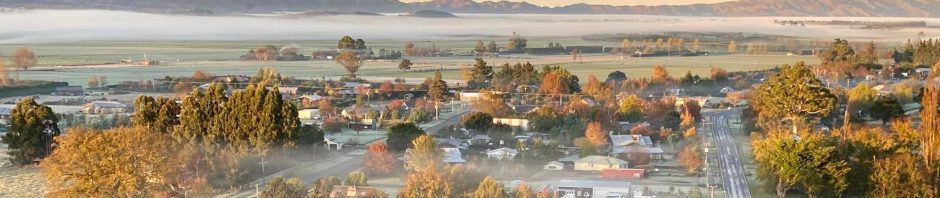
Rotherham and was at one time approximately at the centre of the Amuri County. The Amuri was originally part of the Nelson Province and was mainly settled and stocked from that area.
It became part of Canterbury in 1876. George Duppa freeholded his holding in 1855, and sold out to Rhodes Brothers and Wilkin in 1863. They sold St. Leonards by auction in 1877 as 9 stations, 19 farms and a Township, Rotherham. The Township comprised 115 Sections and 27 Farmlets. Rotherham was named after Rotherham in England where the Rhodes were born. The street names in Rotherham, George, Heaton and Sophie were named after family members, Wilkin Street after their Partner and Davison after their Station Manager.
It was intended that the Sections and Farmlets would provide somewhere for Farmworkers to live while working on nearby properties. Further subdivision occurred when Achray, part of the original, was subdivided in 1913. In early years, through lack of trees, firewood had to be obtained from the adjacent riverbed (driftwood) and later peat was dug from swamps and dried. This is possibly why most early buildings were of sod. Trees were planted and the timber milled for houses and farm buildings. Sheep, Beef cattle, and cropping were the main sources of income, but some dairy cows were milked and the milk and cream sold.
Since the advent of irrigation in the 1970’s, dairy farming has increased to a large extent, where most of the flat country is supporting dairy cows and adjoining country is providing grazing for dry stock. However there are still some sheep, and beef cattle farms, and some cropping. In the Rotherham extended area, there is quite a diverse range of soils, varying from light stony soils, to heavy, swampy sols. Like most North Canterbury areas, northerly winds can be a factor, but a lot of shelter has been planted. Rotherham has some impressive heritage buildings including the Rotherham Store (1878) which was also the Post Office for many years and is now also the Mail Centre, and the Rotherham Hotel (also 1878), which was originally a two storied building with stables but was unfortunately burnt down in 1920.
Other historic treasures include Watters Cob Cottage (c 1880) which is believed to be the only one of its type left in New Zealand, and the Amuri Masonic Lodge (c 1909) which was still used for meetings up until only a few years ago before being sold as a residence. The Rotherham School was built c 1880 and both the Anglican Church and Vicarage were built c 1905. In 1998 the Church was sold (and moved to Hopefield, east of Waiau) and the Culverden Church was moved here to replace it. The Rotherham Hospital was built c 1922 and was used by the surrounding areas for Maternity Patients as well as medical cases. It closed in 1960 and is now a Residence.
The Medical centre now at Rotherham was opened in 1982, and all services are co-coordinated from there. A new medical centre will be built in Rotherham this year to keep up with growth and changes in the communities needs. The Domain was formed in 1926 and since 1930 has been the venue for the Amuri A & P Show.
The Rotherham Memorial Baths were opened in 1955 and were built mainly with voluntary labour which is typical of the Community Spirit in the area. They were erected as a memorial to the servicemen and woman from the area who served overseas in the two World Wars. The Rotherham Hall was built in 1913 and is still used for various purposes by the Community. The Railway reached Rotherham about 1914 and was closed around about 30 years ago (c.1979).
Rotherham Township always had Builders, Fencers, Shearers, Farm Workers, Agricultural Contractors, Stock Buyers and Agents and often had Council employees. Rotherham used to have a Blacksmith Shop (later transferred to Culverden and still there as General engineers), a Butcher Shop, a Fish Shop, and an area Stock Inspector. The commanding views, recreational opportunities and the friendly and helpful attitude of the Residents makes Rotherham a popular place to live.
 Amuri Manor – Boutique Country Accommodation | Historic 1922 Hospital, North Canterbury